|
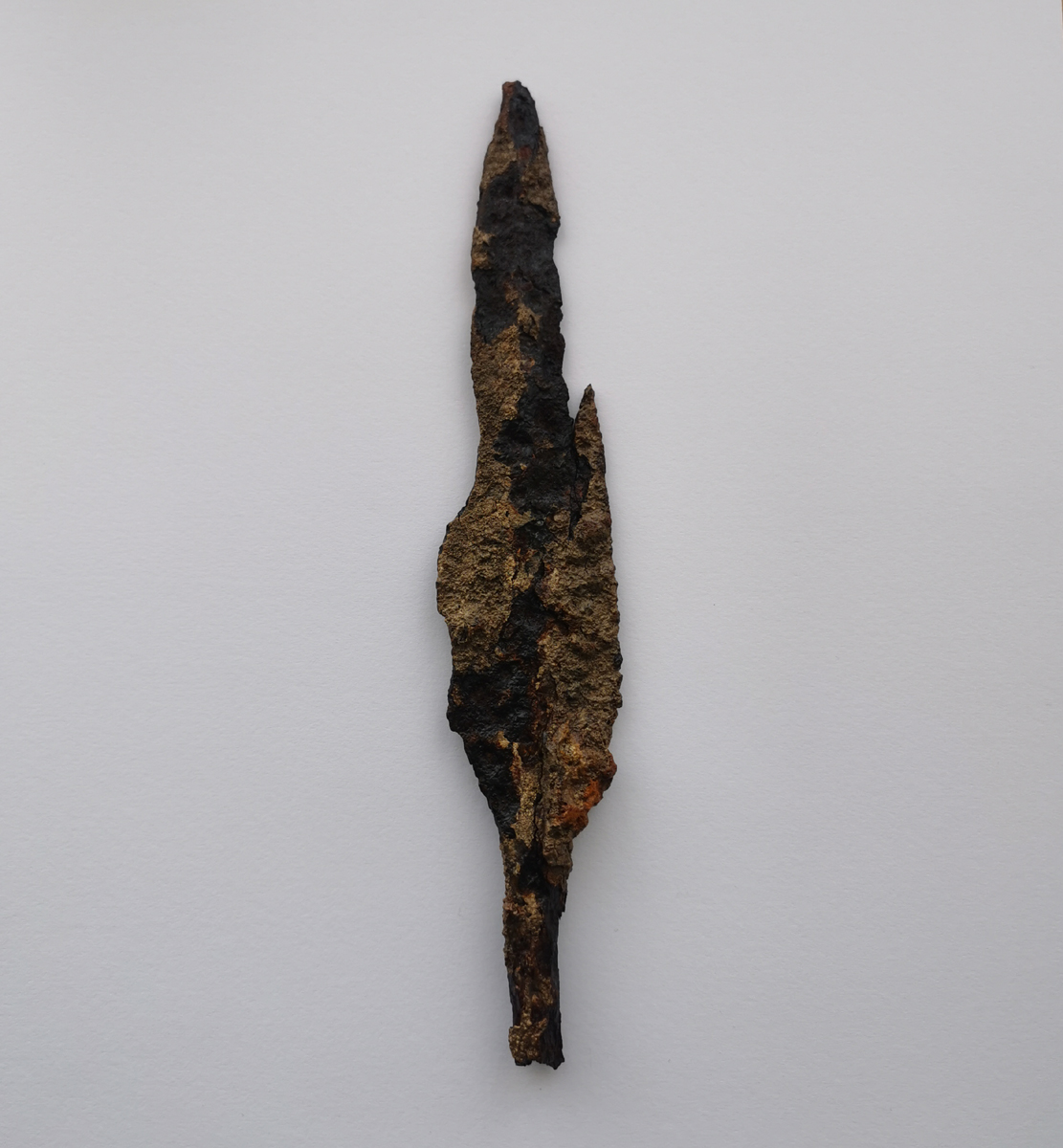
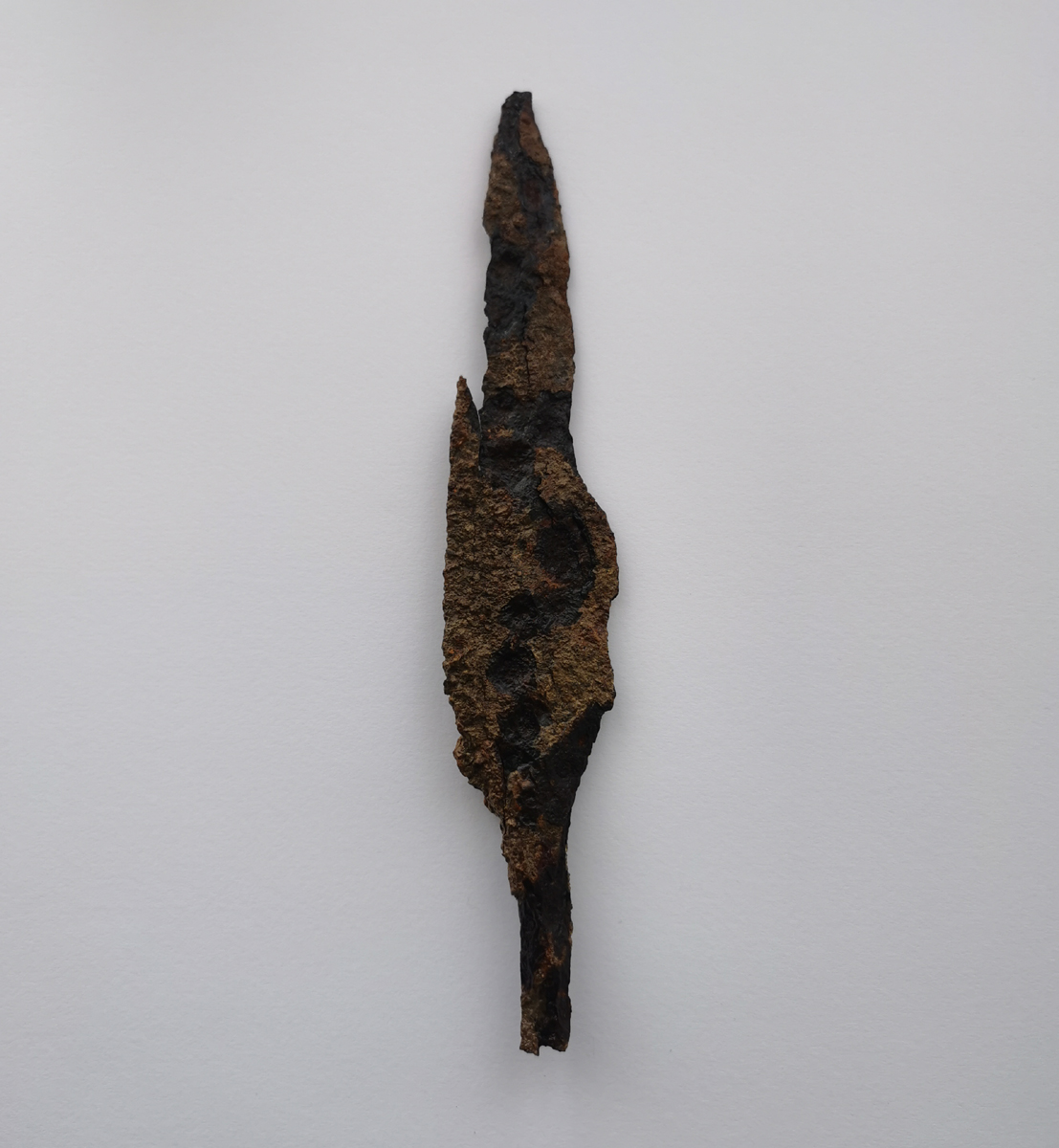
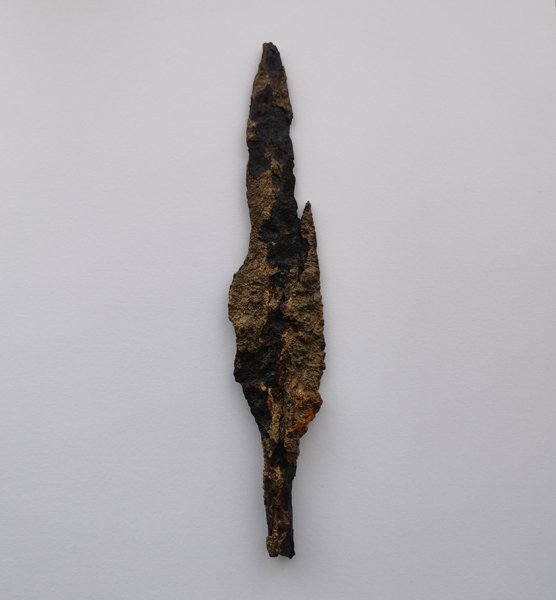
This is a roman javelin spearhead that was found in Suffolk, East Anglia, home of Boudicas Iceni tribe and where legionaries of the Legio IX Hispana (Ninth Iberian Legion) were stationed following the roman invasion in 43 AD. The spearhead would have belonged to a soldier in an auxiliary unit commanded by a centurion.
The spearhead was found with six other weapons that were presumably hidden/buried together and never recovered. I'm happy to date it to between 70 - 120 AD, which fits well with the roman army presence in East Anglia.
Condition: Stable. Loss to sides of blade and socket. This weapon has been stored under controlled conditions since purchased over two decades ago. It has now been cleaned of loose material and I have sealed it with a clear acrylic protective coat to exclude air. It can now be safely displayed. There are areas of dried soil/mud present on the surface of the metal that I decided to leave in place, as to try to remove them might have further degraded the spear. These weapons must have been preserved in anaerobic conditions (hence their survival). Note the preserved remains of the wooden shaft still inside the spear!
Dimensions: Length: 25cm.
Provenance: From a collection of roman weapons auctioned in January 2005; found in Suffolk, East Anglia, England.
£210.00
Following the Roman invasion of Britain in A.D.43, Legio IX Hispania swept north and soon appear amongst the provincial garrison. In AD 50, the Ninth was one of two legions that defeated the forces of Caratacus at Caer Caradoc. Around the same year, the legion constructed a fort, Lindum Colonia, at Lincoln. Under the command of Caesius Nasica they put down the first revolt of Venutius between AD52 and 57.
The Ninth suffered a serious defeat at the Battle of Camulodunum under Quintus Petillius Cerialis in the rebellion of Boudica (AD61), when most of the foot-soldiers were killed in a disastrous attempt to relieve the besieged city of Camulodunum (Colchester). Only the cavalry escaped. The legion was later reinforced with legionaries from the Germania provinces. When Cerialis returned as governor of Britain ten years later, he took command of the Ninth once more in a successful campaign against the Brigantes in 71-72, to subdue north-central Britain. Around this time they constructed a new fortress at York (Eboracum), as shown by finds of tile-stamps from the site.
The unknown fate of the legion has been the subject of considerable research and speculation. One theory (per historian Theodor Mommsen) was that the legion was wiped out in action in northern Britain soon after 108, the date of the latest datable inscription of the Ninth found in Britain, perhaps during a rising of northern tribes against Roman rule. This view was popularised by the 1954 novel The Eagle of the Ninth in which the legion is said to have marched into Caledonia (modern day Scotland), after which it was "never heard of again".
© Minerva Antiquities 2026 All rights reserved
Powered by w3.css