|
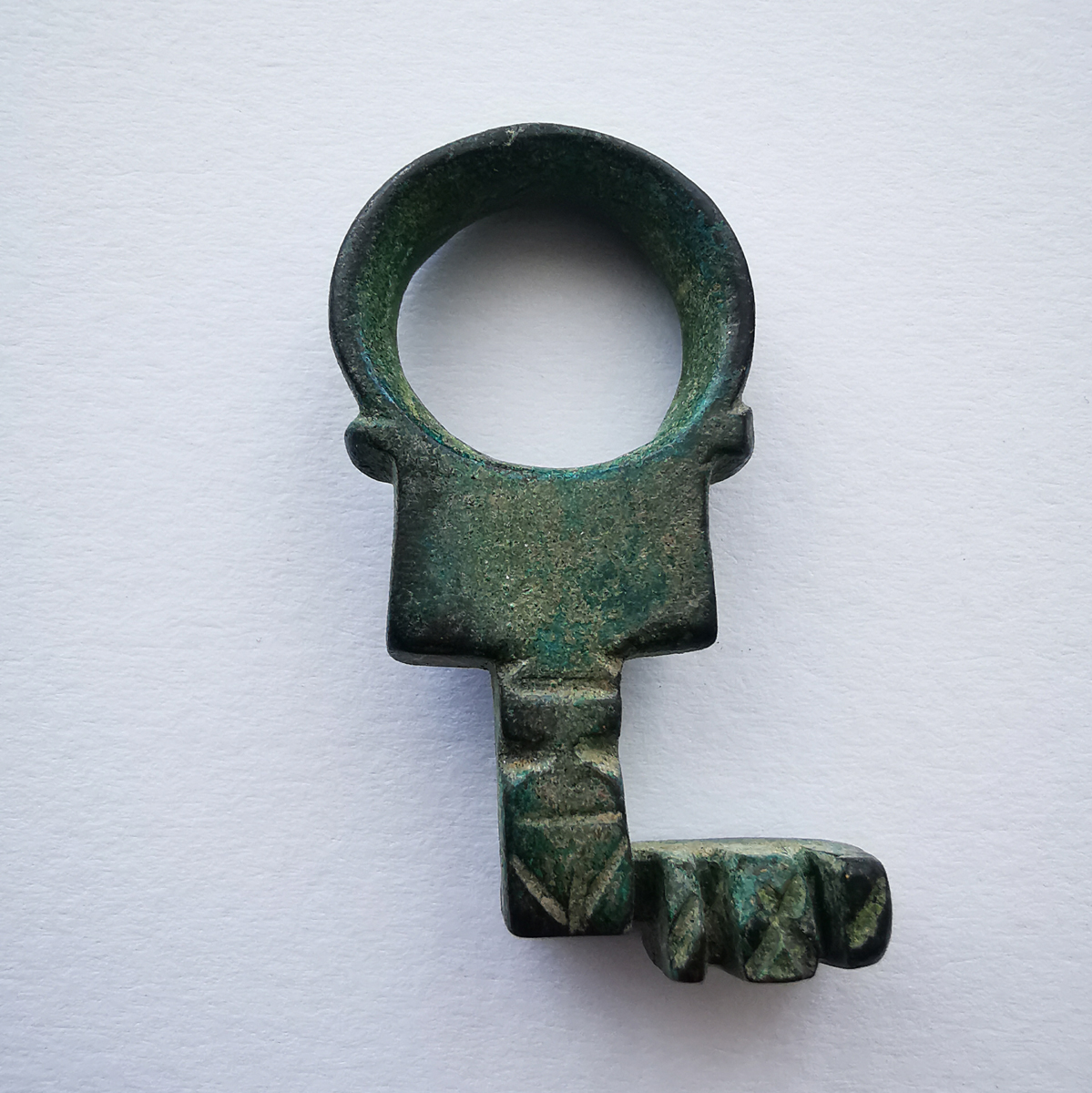
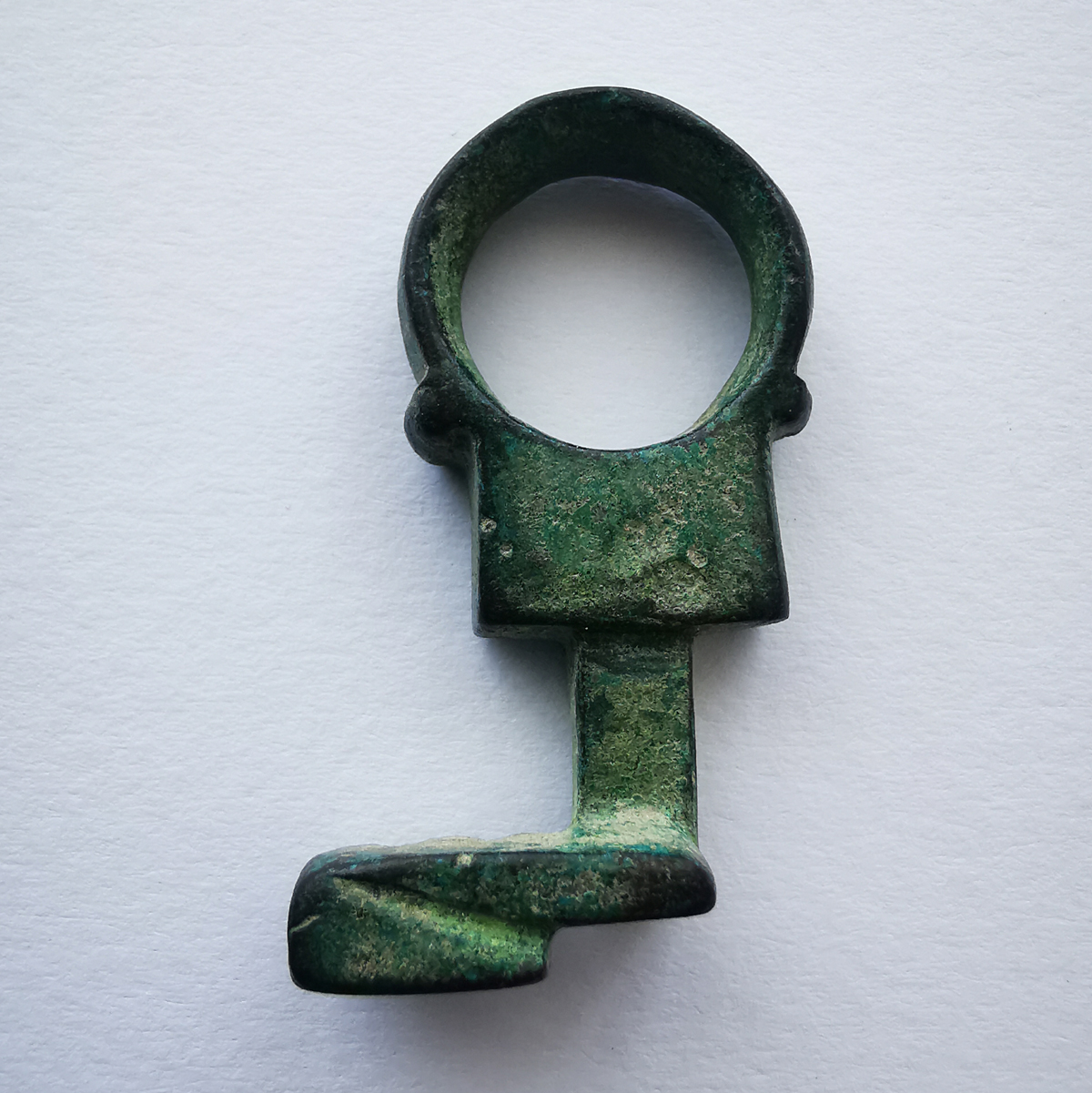
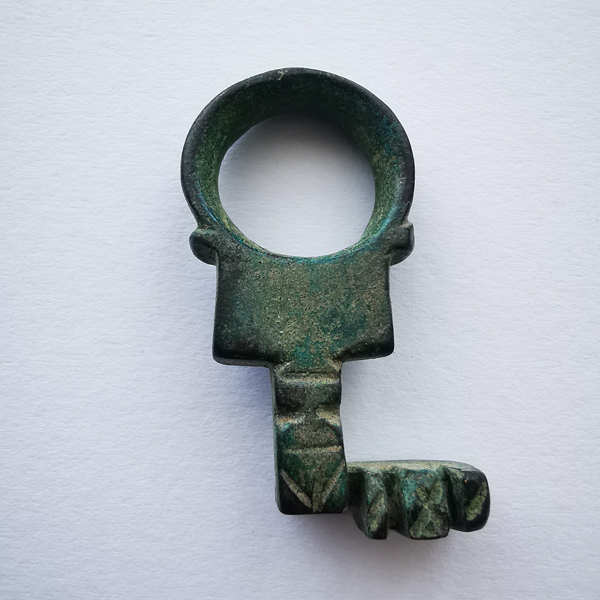
A fine Roman bronze key. Formed of a loop, main shaft and notched lugs perpendicular to the head of the key.
The notch is quite sophisticated, with sturdy pins cut at an angle. This key likely locked away something valuable, and the circular loop on the head would have allowed the bearer to keep it close on a finger or chain. While there are many examples of Roman keys, few are this well preserved.
Condition: Extremely fine, Lovely deep green patina. A very well preserved example.
Dimensions: Length 4.2cm.
Provenance: Ex. private collection, Hampshire, UK; acquired at UK auction.
£40.00
According to the Roman writer Pliny the Elder, keys were the invention of Theodorus of Samos in the 6th Century BC and have remained a necessary tool for daily life over the centuries. Roman keys were used for doors, chests, boxes, caskets, cupboards and padlocks. Sometimes they were used for ceremonial or decorative purposes, such as matron keys, jewelry items and votive offerings. It is alleged that some ring keys were worn by women as symbols of household authority, this is probably true, but are difficult to identify as having served that purpose. Indeed the purposes of many keys is unclear.
Many Roman keys are composite keys. These keys combined a bronze handle with an iron shank. This meant that the handle could be mass-produced by casting in a mold and then assembled with an individually made shank. Unfortunately, this also allows fakers to create keys in the same way, taking genuine but worthless rusty iron with separated ancient or freshly cast handles.
Door locks were sometimes made of wood, usually with iron keys, but sometimes of bronze. Such locks have not survived, but the keys have been found. The latch lifter was a primitive key, a very simple metal, bone or ivory shaft with a hook or a couple of teeth on the end. In use, it was to pass through a hole in a door and fit into a latch to lift and move it. Such keys were not really intended for serious security, but more as a convenience in lifting the inside bolt. A variety of latch lifters were found at Vindolanda.
Iron latch lifters are found in two types: L-shape and T-shape. The L-shape is most common. For an extensive discussion of these iron keys, see Manning 1985.
Figural keys (as representations of living beings) are the much sought-after, rare, and the most expensive Roman keys to collect. Unfortunately they are widely faked and so should be acquired with the greatest care. Reproductions with fantasy designs are common.
Locks using rotary keys were first developed by the Romans. These keys are instantly recognizable to us today as they resemble those in common use until the last century. Rotary keys were also usually warded. They were contemporaneous with pin tumbler locks and keys, as shown by examples from Pompeii. All rotary keys found at Pompeii have hollow stems, turning on a key post.
Long warded, or lift keys, are one of the least common types, while warded ring keys are relatively abundant. Roman ring keys could also be displayed as a type of jewelry.
Complex warded lift keys are rare and little understood, with no attempts to explain their usage. These keys with two sets of bits at right angles were likely the Roman version of high security keys, and may have been used for two different locks, probably adjacent, i.e. two keyholes for two separate locks for a strong-box? A chest with two locks with two different mechanisms was a higher security protection for the family's treasures.
© Minerva Antiquities 2026 All rights reserved
Powered by w3.css